


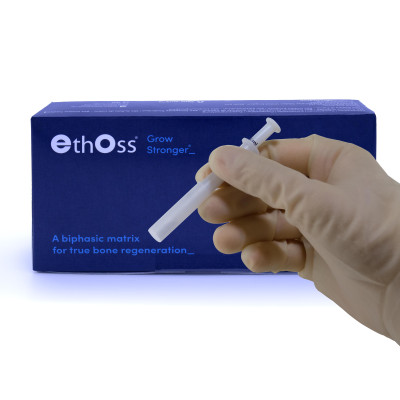
$467.00 Pre-Order

| Article: | EthOss® 0,25 |
| Brand: | EthOss® |
| Availability: | Pre-Order |
EthOss® is a synthetic bone graft used for filling, augmentation, and reconstruction of bone defects in the maxillofacial region. The material is commonly applied in intrabony defects, alveolar ridge augmentation, and socket preservation after tooth extraction.
The key differentiating feature of EthOss lies in the combination of β-tricalcium phosphate and calcium sulfate. This combination creates a stable, controllable consistency and allows the material to function as a graft with built-in stabilization during placement.
The material consists of 65% β-tricalcium phosphate and 35% calcium sulfate.
β-tricalcium phosphate forms an osteoconductive scaffold for bone formation, while calcium sulfate provides cohesion and stability during placement.
In practice, this results in reduced granule dispersion and easier defect shaping.
EthOss is typically fully resorbed within 6–12 months.
This approach is often preferred by clinicians who avoid materials that remain in tissues long-term and expect gradual replacement of the graft with native bone.
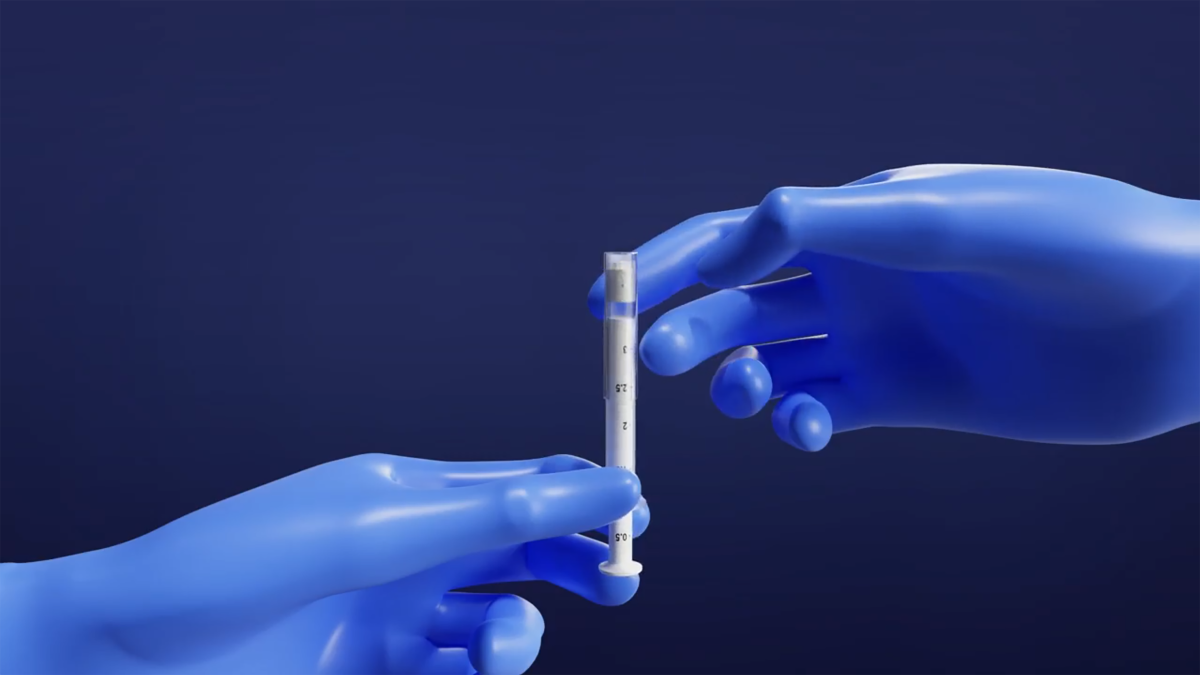
Only sterile 0.9% NaCl saline solution is used for mixing.
This reduces variability within the protocol and allows for a stable, predictable consistency.
The recommended re-entry time is approximately 12 weeks.
This timing is convenient for follow-up or second-stage procedures; however, the final decision should always be based on clinical findings and CT or radiographic assessment.
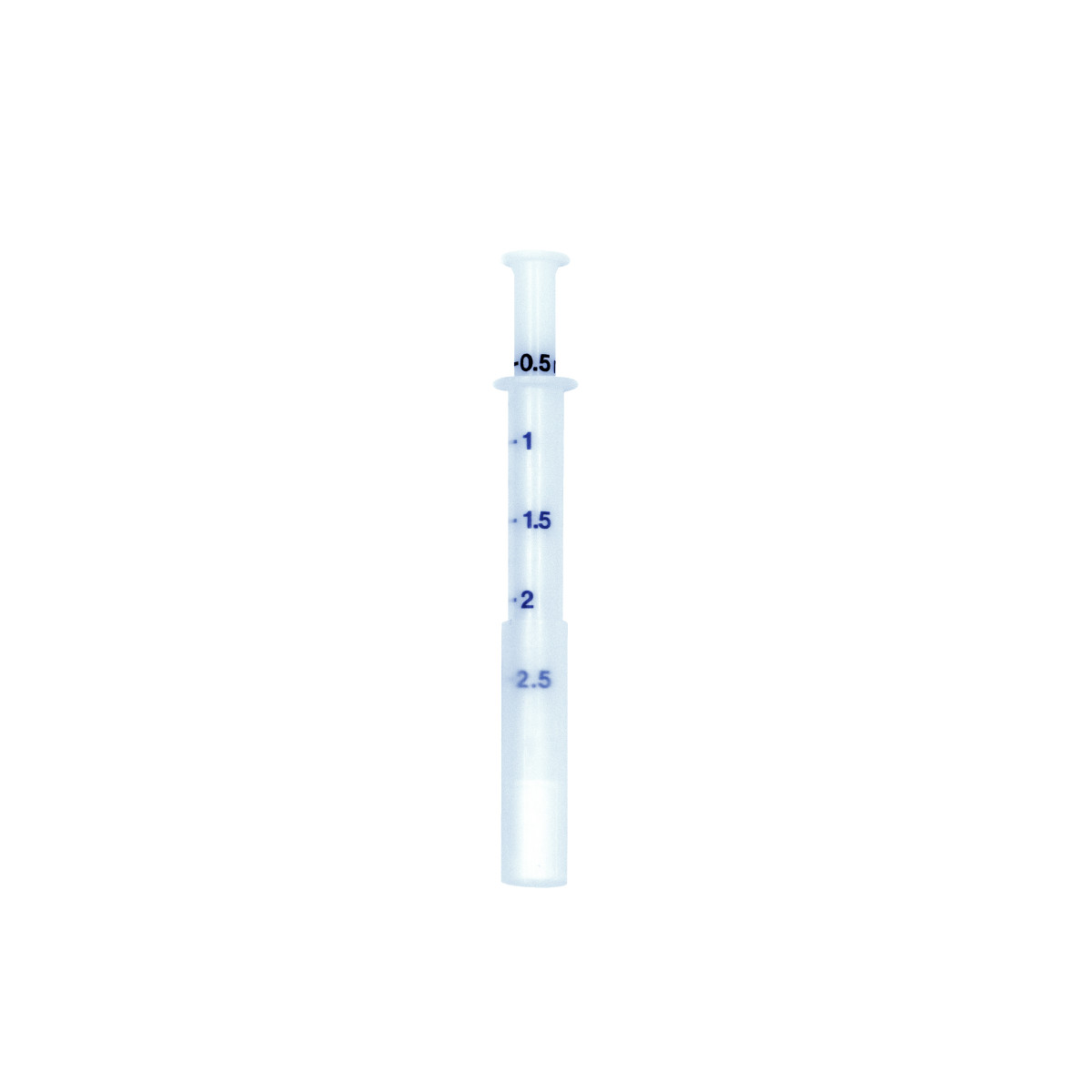
EthOss is available in 3×0.25 cc, 3×0.5 cc, and 3×1 cc formats.
This allows precise volume selection for single sockets or localized defects without material waste.
Implantologist and surgeon
Fast protocols, material stability, and predictable timelines are essential. EthOss offers re-entry at approximately 12 weeks and complete resorption within 6–12 months based on declared data.
Periodontist
Key factors include suitability for intrabony defects and a clear healing timeline. EthOss indications include infrabony defects, meeting these clinical requirements.
Maxillofacial surgeon and complex reconstructions
Such cases typically require materials with predictable quality, defined parameters, and evidence-based performance. EthOss has a synthetic composition with declared resorption and timing parameters; however, in large defects, protocols involving membranes, blocks, or fixation are often preferred. EthOss does not replace surgical logic but integrates into it.
|
Criterion |
EthOss® |
Geistlich Bio-Oss |
botiss cerabone |
botiss maxresorb |
|
Type |
synthetic graft |
xenograft (bovine-derived) |
xenograft (natural bone mineral) |
synthetic BCP |
|
Composition |
65% β-TCP + 35% CaSO₄ |
bovine granules (natural substitute) |
100% natural bone mineral, high crystallinity |
60% HA + 40% β-TCP |
|
Resorption |
complete usually 6–12 months |
usually very slow/partial (volume stability is a strength) |
high volume stability |
“improved resorption” (positioning) |
|
Strength |
pure synthetic + timing + convenient protocol |
“gold standard” of xenografts, high credibility/documentation |
premium xenograft with high volume stability |
synthetic alternative to BCP with HA/β-TCP balance |
|
Compromise |
not a “magic wand” for all defects without additional solutions |
not synthetics (not for all patients by conviction) |
also not synthetics |
different philosophy than EthOss; choice under the protocol |
EthOss® is a fully synthetic material used for filling and reconstruction of bone defects in the oral and maxillofacial region. The material is applied in intrabony defects, alveolar ridge augmentation, and socket filling after tooth extraction.
EthOss is based on a combination of 65% β-tricalcium phosphate and 35% calcium sulfate, which determines the material’s behavior during placement and throughout the bone remodeling process.
EthOss® is a synthetic bone substitute for implantology and periodontology, combining 65% β-tricalcium phosphate and 35% calcium sulfate. The material is mixed with standard 0.9% NaCl saline, the recommended re-entry time is 12 weeks, and complete resorption typically occurs within 6–12 months, according to manufacturer data.
Main indications include intrabony defects, alveolar ridge augmentation, and post-extraction sockets.
What is EthOss® and what is it used for?
EthOss® is a fully synthetic bone graft designed for filling and reconstruction of bone defects in dental practice.
What is the composition of the material?
EthOss consists of 65% β-tricalcium phosphate and 35% calcium sulfate, providing osteoconductive properties and material stability during placement.
How long does the material resorb?
Complete resorption of EthOss usually occurs within 6–12 months, according to manufacturer data.
What should be used to mix the material before placement?
EthOss should be prepared using only standard sterile 0.9% NaCl saline solution.
When is the second surgical stage usually planned?
The recommended re-entry time after EthOss placement is approximately 12 weeks, according to manufacturer data.
In which clinical situations is the material indicated?
EthOss is indicated for intrabony defects, alveolar ridge augmentation, and socket filling after tooth extraction.
The price is indicated for 1 box (in the box - 3 syringes of the appropriate dosage).
To order, contact the managers of the MDS company
+38 (068) 337 37 37
$467.00 Pre-Order
$571.96 Pre-Order
$398.98 Pre-Order